
1925: A Literary Encyclopedia
The year 1925 was arguably the peak of literature’s centrality. There were more magazines, more journals, more reviews, more book news, and more book gossip than ever before or since. Literature’s rivals for cultural attention were on the rise—film was becoming a more significant part of people’s media diet, radio was just taking off, television technologies were advancing—but literature was still king. Even mediocre books got dozens of reviews, and the reviews were (most often) thoughtful and intellectually engaged. The belief that literary writing was an essential and consequential business was nearly universal. Modernist ferment continued to excite discussion while the pulp revolution in genre fiction—detective stories, science fiction, Westerns, romance—was booming. These popular books, even if sometimes condescended to, were also given thoughtful review attention.
This encyclopedia was written as we approached the 100th anniversary of the annus mirabilis. In what follows, we can see the seeds of virtually every aspect of our cultural life, from art, literature, theater, and music to physics, philosophy, social science, and political discourse. The fear of environmental degradation, the corruption in our politics, the competing claims of utopianism and dystopia, the bitterly divided views on science, mass media, art, nature, justice, generations, community, freedom, sexuality, race, immigration—all can be seen in their budding or full-blown gore and glory in 1925. We have come far and not very far at all.
More info →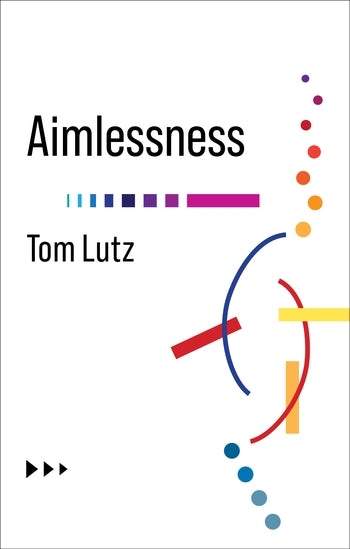
Aimlessness
Our culture values striving, purpose, achievement, and accumulation. This book asks us to get sidetracked along the way. It praises aimlessness as a source of creativity and an alternative to the demand for linear, efficient, instrumentalist thinking and productivity.
Aimlessness collects ideas and stories from around the world that value indirection, wandering, getting lost, waiting, meandering, lingering, sitting, laying about, daydreaming, and other ways to be open to possibility, chaos, and multiplicity. Tom Lutz considers aimlessness as a fundamental human proclivity and method, one that has been vilified by modern industrial societies but celebrated by many religious traditions, philosophers, writers, and artists. He roams a circular path that snakes and forks down sideroads, traipsing through modernist art, nomadic life, slacker comedies, drugs, travel, nirvana, and oblivion. The book is structured as a recursive, disjunctive spiral of short sections, a collage of narrative, anecdotal, analytic, and lyrical passages—intended to be read aimlessly, to wind up someplace unexpected.
Disocunt code CUP@) gives 20% off at Columbia UP site.
More info →

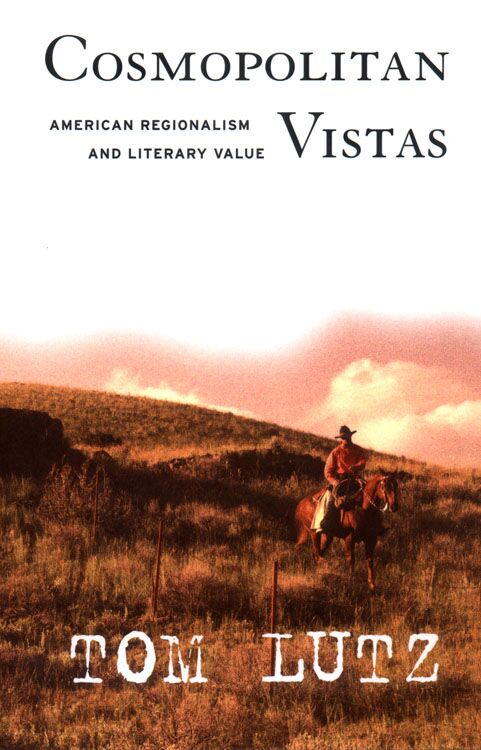
Cosmopolitan Vistas: American Regionalism and Literary Value
In a major statement on the relation of art and politics in America, Tom Lutz identifies a consistent ethos at the heart of American literary culture for the past 150 years. Through readings of Sherwood Anderson, Willa Cather, Hamlin Garland, Ellen Glasgow, Sarah Orne Jewett, Sinclair Lewis, Edgar Lee Masters, Claude McKay, Edith Wharton, Anzia Yezierska, and others, Lutz identifies what he calls literary cosmopolitanism: an ethos of representational inclusiveness, of the widest possible affiliation, and at the same time one of aesthetic discrimination, and therefore exclusivity.
At the same time that it embraces the entire world, in Lutz’s view, literary cosmopolitanism necessitates an evaluative stance, and it is this doubleness, this combination of egalitarianism and elitism, that animates American literature since the Civil War. The nineteenth century’s realists and sentimentalists, the writers of the Harlem Renaissance and of the Southern Renaissance, the firebrands who brought in the new canon and the traditionalists who struggled to save the old all ascribe, Lutz argues, to the same cosmopolitan values, however much they disagree on what these values demand of those who hold them.
More info →

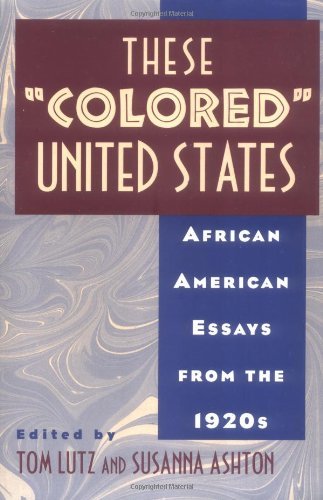
These “Colored” United States
Originally published in The Messenger, these essays are collected here for the first time, and include pieces on their home states by Wallace Thurman, Anita Scott Coleman, Alice Dunbar-Nelson, Charles S. Johnson, E. Franklin Frazier, Wallace Thurman, & George Schuyler.
More info →